



EUnetCCC: Europe sets ambitious target of 100 certified Cancer Centres by 2028



The European Commission will officially launch the European Network of Comprehensive Cancer Centres (EUnetCCC) during its first Annual Meeting, held at the CNIT Forest, Paris La Défense. The event will bring together over 1,000 stakeholders, including national and EU policymakers, clinicians, researchers, and patient representatives.
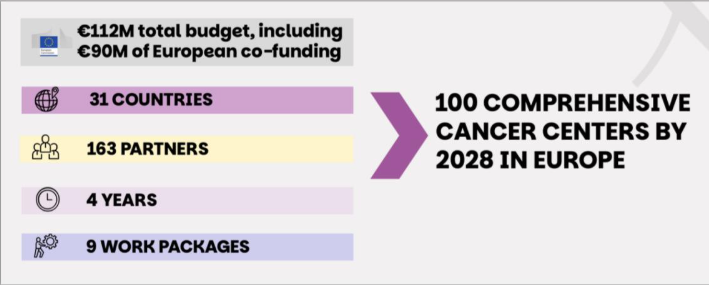
Launched as a Joint Action under the EU4Health programme, EUnetCCC aims to connect 100 Comprehensive Cancer Centres across Europe by 2028, ensuring that 90% of eligible patients have access to high-quality care, while also strengthening research and education. With a total budget of €112 million, including €90 million of European co-funding, it stands as the largest health initiative ever supported by the European Commission.
To build a sustainable European network of Comprehensive Cancer Centres (CCCs) – reference centres integrating high-quality cancer care, research, and education is one of the main goals. The network will serve as a strategic infrastructure to support Member States in strengthening national cancer systems, reducing inequalities, and delivering innovation-driven, high-quality cancer care.
“The EUnetCCC is a crucial EU4Health Joint Action, managed by HaDEA, that will benefit European citizens with improved diagnostics, treatment options and care. The trans-European collaboration and exchange of best practices across borders will lead to strengthening national cancer systems. Moreover, this Joint Action will ensure better and more equitable access to cure across the EU, embodying a true spirit of European solidarity.”, clarifies Marina Zanchi, Director, European Health and Digital Executive Agency (HaDEA).
The event will bring together over 1,000 stakeholders, including national and EU policymakers, clinicians, researchers, and patient representatives. This will mark a decisive step in the implementation of Europe’s Beating Cancer Plan, positioning EUnetCCC as a transformative instrument to improve cancer outcomes across the EU.
“This network is a turning point for oncology in Europe. With 163 partners across 31 countries, EUnetCCC will bring coherence, quality, and equity to the forefront of cancer care across all Member States. By 2028, we aim to have at least 100 certified Comprehensive Cancer Centres operating in Europe, ensuring that 90% of eligible patients have access to high-quality care. It’s not just a project it’s a foundational structure for the future of cancer in Europe” reinforces Prof. Norbert Ifrah, president of the French National Cancer Institute.
“EUnetCCC lays the foundation for a pan-European infrastructure that will accelerate innovation, improve patient outcomes, and support sustainable cancer systems” – Prof. Norbert Ifrah.
The initiative is built around five interlinked strategic objectives:
- Structure a sustainable European Network of CCCs: Establish a framework that connects leading cancer centres across Europe, enabling structured collaboration and alignment with EU cancer priorities.
- Define and implement a European certification model for CCCs: Develop and apply common quality standards and certification criteria to recognise centres that provide truly comprehensive, high-performing cancer care and research.
- Promote capacity-building and reduce inequalities: Provide practical tools, training opportunities, and peer support to help cancer centres – meet EU standards and overcome resource disparities.
- Enhance knowledge sharing and thematic collaboration: Foster cross-border cooperation on key themes such as prevention, survivorship, digital oncology, and personalised medicine, through dedicated working groups and pilot projects.
- Secure long-term sustainability and integration into national policies: Advocate for institutional and political support to maintain the network beyond the Joint Action period, ensuring its integration into national cancer strategies and EU-level planning.
Annual Meeting: two days of strategic dialogue and action
The EUnetCCC Annual Meeting will serve as the official launch platform for the network and a space for strategic alignment between EU institutions, Member States, and cancer care providers.
The programme includes:
- Plenary sessions presenting the EUnetCCC framework, certification framework, and value proposition
- Parallel discussions on capacity-building, governance, patient involvement, workforce development, and digital health
- Joint sessions with complementary initiatives such as JANE-2, highlighting synergies between European oncology networks
- A launch session for the EUnetCCC White Paper, calling for sustained engagement and integration beyond 2027
“EUnetCCC lays the foundation for a pan-European infrastructure that will accelerate innovation, improve patient outcomes, and support sustainable cancer systems”, Thomas Dubois.
Event Details
Venue: CNIT Forest, La Défense – Paris
Dates: 6–7 November 2025
Schedule: 09:00–17:00
Note: It will be an in-person event only
Press Office: Sofia Coelho Silva, +351 91 487 69 64
About EUnetCCC
EUnetCCC is the largest Joint Action ever launched under the EU4Health programme, with total eligible costs of approximately €112 million and an EU contribution of €89.6 million (Grant Agreement No. 101183407). Coordinated by France’s National Cancer Institute (INCa), it brings together over 160 partners from 31 countries to build a truly pan-European network of Comprehensive Cancer Centres (CCCs).
As Flagship No. 5 of Europe’s Beating Cancer Plan, the initiative supports the EU objective that by 2030, 90% of eligible patients should have access to a Comprehensive Cancer Centre. Launched in 2024, EUnetCCC is establishing an EU-wide certification scheme and connecting centres across borders so that excellence in care, research, education and innovation becomes accessible to all European citizens, regardless of where they live.